Full Mouth Rehabilitation with T-Scan: How Digital Bite Analysis Helps Patients in Nallakunta
Losing multiple teeth, living with worn-down enamel, or dealing with a bite that never quite feels “right” can affect far more than your smile. It can change the way you eat, speak, and even hold your jaw. For residents looking for full mouth rehabilitation in Nallakunta, modern dental technology has made treatment planning more precise and predictable. With T-Scan digital bite analysis, dentists can measure how your teeth meet, including the timing and distribution of bite forces. This detailed information helps guide full mouth rehabilitation in Nallakunta, allowing dentists to plan and fine-tune restorations for improved comfort, function, and a more balanced bite.
This article breaks down what full mouth rehabilitation involves, how T-Scan technology works, and why patients from Nallakunta and nearby neighborhoods are choosing this modern, data-driven approach for lasting results.
What Is Full Mouth Rehabilitation?
Full mouth rehabilitation (also called full mouth reconstruction) is a comprehensive dental treatment plan that restores every tooth in the upper and lower jaw. It isn’t one single procedure; it’s a combination of treatments designed around your specific bite and oral health needs.
You might need it if you have:
- Multiple missing or badly damaged teeth
- Severe tooth wear from grinding (bruxism) or acid erosion
- Chronic jaw pain, headaches, or clicking sounds while chewing
- A collapsed bite due to long-term tooth loss
- Old crowns, bridges, or fillings that no longer fit correctly
- Gum disease that has affected the supporting bone structure
What Is T-Scan Digital Bite Analysis?
Traditionally, dentists checked a patient’s bite using a thin sheet of colored articulating paper. The patient bites down, and the marks left behind give a rough idea of where the teeth touch. The problem? This method only shows where contact happens not how hard, how long, or in what sequence.
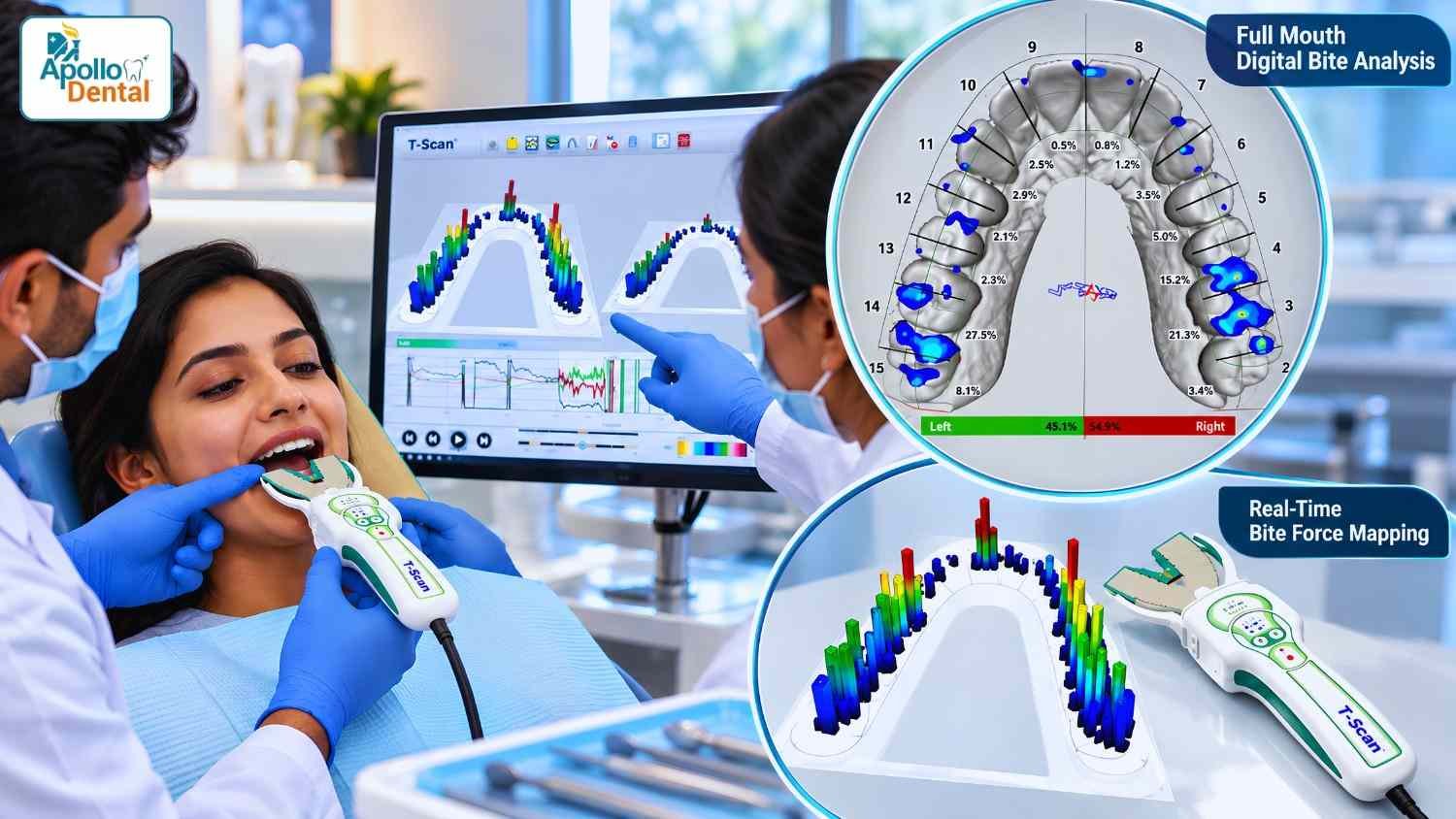
T-Scan solves this. It’s a computerized sensor system that captures your bite in real time and displays it as a color-coded map on a screen. As you close your mouth, the device records:
- The exact force applied at every contact point
- The timing of each contact (which teeth touch first, second, and last)
- Any imbalance between the left and right sides of the jaw
- Pressure spikes that could point to future cracks, sensitivity, or joint strain
Instead of relying on a dentist’s visual judgment alone, T-Scan turns bite correction into a precise, measurable process.
How T-Scan Improves Full Mouth Rehabilitation Outcomes
Combining T-Scan with full mouth rehabilitation offers several practical advantages:
- More accurate diagnosis: Hidden bite imbalances that cause jaw pain or tooth sensitivity are often invisible to the naked eye but show up clearly on the T-Scan display.
- Faster adjustments: Instead of repeated trial-and-error visits, the dentist can fine-tune crowns, bridges, or implants in real time based on live data.
- Longer-lasting restorations: New crowns, veneers, or implants placed with a balanced bite are far less likely to chip, crack, or loosen prematurely.
- Reduced jaw strain: Correcting uneven forces can ease symptoms linked to TMJ (jaw joint) discomfort.
- Objective before-and-after comparison: Patients can see printed or on-screen proof of how their bite has improved after treatment, which builds confidence in the outcome.
Step-by-Step: The Full Mouth Rehabilitation Process
Every case is different, but a typical full mouth rehabilitation journey generally follows this sequence:
- Comprehensive examination: Digital X-rays, scans, and a detailed review of gum health, tooth structure, and jaw function.
- T-Scan bite mapping: A quick, painless recording of your natural bite to identify force imbalances and contact timing issues.
- Treatment planning: Based on the findings, the dentist designs a customized plan that may include crowns, bridges, implants, veneers, root canal therapy, or gum treatment.
- Preparatory procedures: Any necessary extractions, gum therapy, or bone-related treatment is completed first to create a healthy foundation.
- Restoration placement: New crowns, bridges, or implant-supported teeth are fitted in planned stages rather than all at once, allowing the bite to be checked at every step.
- Bite verification with T-Scan: Once restorations are in place, a follow-up scan confirms that pressure is evenly distributed across the arch.
- Fine-tuning and review: Minor adjustments are made until the bite reading shows a balanced, symmetrical result.
- Maintenance visits: Periodic check-ups ensure the restorations continue to function correctly over time.
Author Bio

Foinix Digital
Foinix Digital Services believes every story has the power to inspire and connect. With a passion for creativity and meaningful storytelling, we craft content that brings ideas to life and helps brands share their voice with the world.
Recent Posts

Dental
November 10, 2025

Dental
April 23, 2026
Book Appointment
Who Should Consider Full Mouth Rehabilitation?
This treatment approach is generally suitable for patients who:
- Have lost several teeth over the years and struggle to chew properly
- Experience frequent jaw fatigue, clicking, or morning headaches
- Have worn their teeth down significantly from grinding
- Feel self-conscious about the appearance of their smile due to damage or gaps
- Have had multiple dental repairs in the past that keep failing
A short consultation is usually enough to determine whether full mouth rehabilitation, or a smaller targeted treatment, is the right fit for your situation.
Why Patients Around Nallakunta Choose This Approach
Nallakunta sits close to several well-connected residential pockets, and many patients travelling in for full mouth rehabilitation come from nearby areas such as DD Colony, Barkatpura, Adikmet, Chikkadpally, Narayanguda, Vidyanagar, and Shivam Road. For families in these neighborhoods, having access to advanced, technology-backed dental care close to home means fewer long-distance trips for what is often a multi-stage treatment.
A few reasons local patients prefer a T-Scan-assisted approach over the traditional method:
- Fewer repeat visits for bite correction, since adjustments are guided by real data
- Clear communication as patients can see their own bite readings and understand exactly what is being corrected
- Better long-term comfort, since restorations are calibrated rather than estimated
- Convenient scheduling for staged treatments, which matters when multiple appointments are needed over several weeks
Whether you’re commuting from a nearby colony or already living in the neighborhood, proximity to a clinic that combines experienced clinical judgment with precise digital tools can make a genuinely stressful treatment feel far more manageable.
Caring for Your Smile After Full Mouth Rehabilitation
Once your treatment is complete, a few simple habits go a long way in protecting your investment:
- Brush twice daily with a soft-bristled brush and clean between restorations using floss or interdental brushes
- Avoid chewing on very hard foods, ice, or pen caps, which can chip new crowns
- Wear a night guard if you have a history of teeth grinding
- Keep up with six-monthly professional cleanings and check-ups
- Report any sensitivity, discomfort, or bite changes promptly rather than waiting
Final Thoughts
Full mouth rehabilitation is a significant investment in both function and confidence, and getting the bite right can help support comfortable, long-lasting results. T-Scan bite analysis Hyderabad provides objective, easy-to-understand data about bite forces and tooth contact, helping dentists reduce guesswork and make precise adjustments throughout the rehabilitation process.
If you live in or around Nallakunta and have been putting off treatment for missing, worn, or damaged teeth, a consultation that includes digital bite analysis is a practical first step toward a more comfortable, long-lasting smile.
FAQ's
Full mouth rehabilitation restores every tooth and the overall bite as a coordinated plan, rather than fixing individual teeth one at a time, it addresses function, appearance, and jaw comfort together.
A thin digital sensor is placed between the upper and lower teeth; as you bite down, it records force, timing, and pressure distribution and displays it as a real-time color map, letting the dentist see exactly where corrections are needed.
Most procedures are done under local anesthesia and completed in planned stages, so discomfort is generally manageable and similar to the standard restorative treatments like crowns or implants.
Depending on the complexity, treatment can take anywhere from a few weeks to a few months, since restorations are placed and bite-tested in stages rather than all in one visit.
A dental examination combined with a T-Scan bite analysis can quickly identify whether the issue affects one or two teeth or involves the overall bite. Consulting the best dentist in Nallakunta can help you understand the findings and determine the appropriate scope of treatment.