
Pain in a Root Canal Treated Tooth – What It Really Means & When Re-RCT Becomes Necessary
You went through the whole thing the appointments, the injections, the crown, and your root canal was supposed to be done. So why does that tooth hurt again?
If you are sitting in Nallakunta or anywhere in Hyderabad wondering why a tooth that root canal has already been treated is giving you trouble, you are not alone. This is one of the most common and confusing situations our patients bring to us at Apollo Dental Nallakunta. And rather than giving you the usual textbook answer, let us walk you through what happens inside your teeth, why that pain comes back, and when a second root canal treatment called Re-RCT becomes the right call.
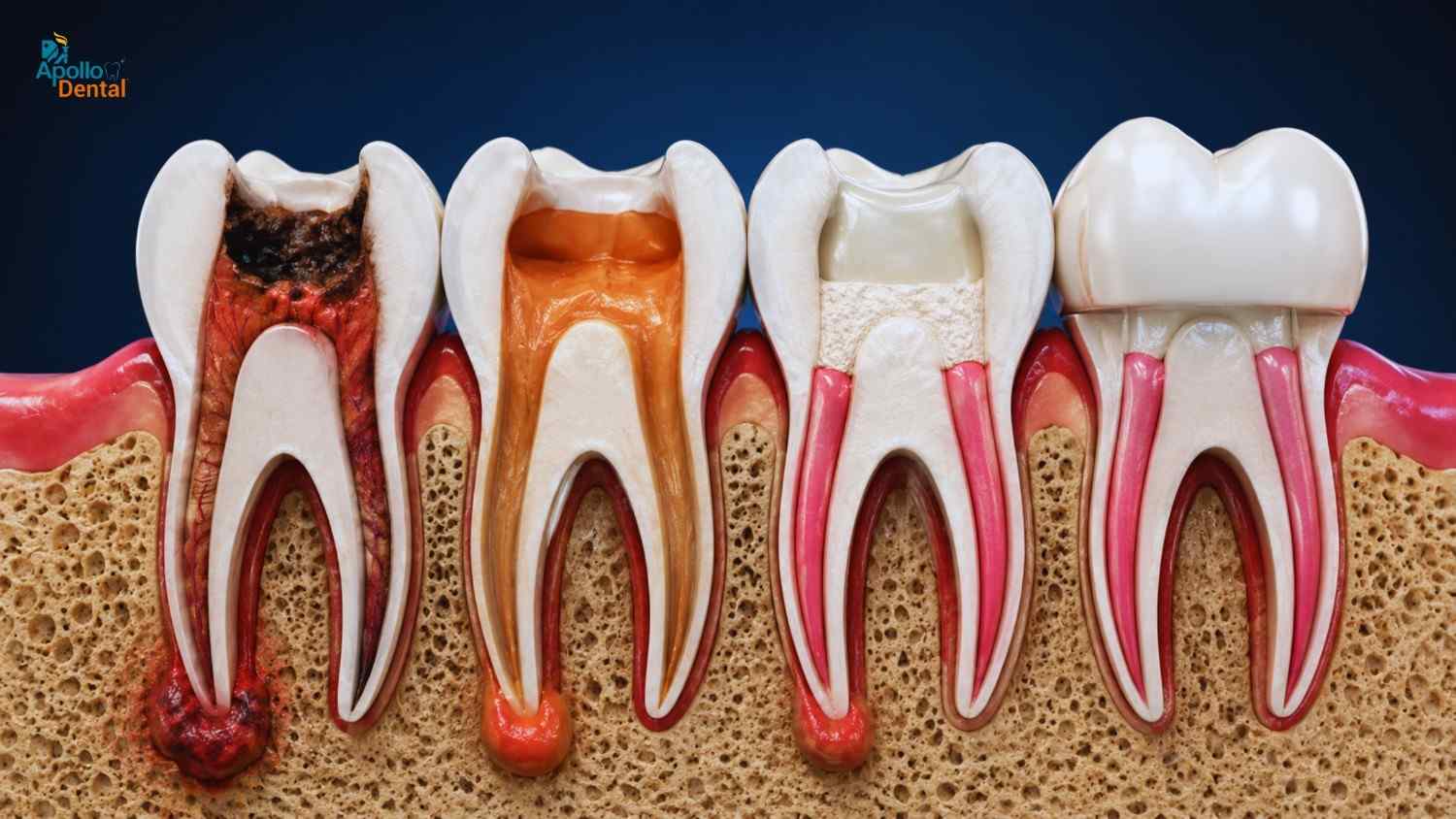
First, Let's Understand What Happens During a Root Canal
When a dentist performs a root canal treatment (RCT), the goal is to remove the infected or inflamed pulp (the soft tissue inside the tooth containing nerves and blood vessels), clean out the canals thoroughly, and seal everything up so no bacteria can get back in. A crown is usually placed on top to protect the treated tooth.
When done correctly, a root canal treated tooth can last a lifetime. The tooth is essentially “dead” – it has no nerve supply anymore, but it remains functional. This is exactly why it should not hurt after healing.
So Why Does a Root Canal Treated Tooth Hurt?
Here is where things get nuanced. There are several real-world reasons why a tooth that has had RCT can become painful again, and not all of them mean the root canal itself failed.
1. Missed or Untreated Canals
Human teeth are not always textbooks. Molars, especially lower molars, can have additional canals that are curved, narrow, or hidden behind other structures. If even one canal is missed during the initial treatment, bacteria continue to thrive inside it, leading to reinfection. This is one of the most common causes of failed root canal treatment, and it is also one of the most fixable reasons to go in for Re-RCT.
2. Incomplete Cleaning or Sealing
Sometimes the canals are identified correctly but not cleaned all the way to the tip (apex), or the filling material does not seal the canal from top to bottom. Gaps, even microscopic ones, are enough for bacteria to colonize and reinfect the tissue at the root tip. Over months or years, this shows up as a new infection, bone loss around the root, or a persistent abscess.
3. Coronal Leakage
This is a situation where the tooth structure above the root canal filling the crown or the filling placed on top develops a leak. Saliva, which is loaded with oral bacteria, seeps down through the restoration and re-contaminates the canals that were previously cleaned and sealed. This is why placing a proper crown promptly after RCT is not optional.
4. A Cracked Tooth Root
This one is tricky because even a high-quality root canal cannot save a tooth with a vertical root fracture. Cracks inside the root allow bacteria to travel in from the periodontal ligament (the tissue surrounding the root), making treatment nearly impossible through conventional means. Pain that is sharp, localized, and triggered by biting down in a specific direction is a strong indicator.
5. Reinfection Due to New Decay
Even a root canal treated tooth can develop new cavities. If decay is left untreated and progresses into the canals, the infection restarts. This is why regular dental check-ups, even after successful RCT, are essential. Patients in Nallakunta and across Hyderabad often assume that once a RCT is “done,” they never have to worry about it again. Unfortunately, that assumption leads to preventable complications.
6. High Bite or Restoration Issues
Sometimes the pain after RCT has nothing to do with infection at all. If the crown or restoration placed after treatment sits even slightly higher than the natural bite, it creates excessive pressure on the treated tooth every time you chew. This causes soreness that can mimic a failed root canal. A quick bite adjustment by your dentist usually resolves this completely.
Author Bio

Foinix Digital
Foinix Digital Services believes every story has the power to inspire and connect. With a passion for creativity and meaningful storytelling, we craft content that brings ideas to life and helps brands share their voice with the world.
Recent Posts

TMD & TMJ
June 27, 2025
Book Appointment
How Do We Know It Is Time for Re-RCT?
At Apollo Dental Nallakunta, we do not recommend retreatment based on symptoms alone. Diagnosis combines clinical examination, digital X-rays, and in some cases, a 3D cone beam CT (CBCT) scan that shows us the canals, root tip, and surrounding bone in three dimensions, something a regular X-ray simply cannot reveal.
Clear indicators for Re-RCT include:
- Persistent or returning pain in a root canal treated tooth lasting more than a few weeks
- Swelling, tenderness, or a sinus tract (a small bump that drains near the tooth) in the gum
- Radiographic evidence of bone loss or an enlarged dark area (periapical lesion) at the root tip that has not resolved or has grown since the last X-ray
- Evidence of missed canals, underfilling, or a void in the root filling seen on X-ray
- Signs of coronal leakage where the crown or restoration has been compromised
If, on the other hand, the X-ray shows a well-filled canal with no bone loss and the discomfort is mild and decreasing, we may first monitor the tooth and manage symptoms conservatively.
What Does Re-RCT Actually Involve?
Root canal retreatment is not simply repeating the original procedure. It is, in some ways, more complex, because the dentist must first undo what was done.
The existing crown or filling is carefully removed to access the tooth. The old root canal filling material (usually gutta-percha) is then dissolved or mechanically removed using specialized rotary instruments. Once the canals are cleared and accessible, the dentist re-examines them, often finding the missing canal or the area of inadequate cleaning that caused the problem in the first place. The canals are then re-cleaned, re-shaped, and re-filled with precision.
At Apollo Dental Nallakunta, Dr. Neela Shiva Tarun, our Conservative Dentistry and Endodontics specialist, handles retreatments with rotary file systems and digital radiography that improve accuracy significantly over older hand-filing techniques. Most Re-RCT cases are completed in one to two comfortable sittings under local anesthesia.
After retreatment, a new crown is typically recommended to re-seal and protect the tooth.
When Is Re-RCT NOT the Right Option?
Retreatment is not always possible or advisable. There are situations where other approaches make more clinical sense:
- Vertical Root Fracture: If the root is cracked longitudinally, no amount of cleaning and refilling will solve the problem. In such cases, extraction followed by a dental implant is often the most durable long-term solution.
- Severely Compromised Tooth Structure: If the tooth has lost too much of its natural crown structure due to decay and cannot support a restoration even after retreatment, keeping it in the mouth may not be worthwhile.
- Apicoectomy (Root-End Surgery): Sometimes the infection is confined to the very tip of the root and cannot be reached through conventional retreatment. In these cases, a minor surgical procedure where the root tip is removed and sealed from the outside (apicoectomy) may be recommended. Our oral surgery team at Apollo Dental Nallakunta performs this with precision when indicated.
The goal is always to save the natural tooth wherever possible, but not at the cost of long-term oral health.
Re-RCT vs. Tooth Extraction and Implant - A Practical Comparison
Re-RCT | Tooth Extraction + Implant | |
Natural teeth preserved? | Yes | No |
Procedure complexity | Moderate | Higher (surgical) |
Time to complete | 1-2 sittings | 3-6 months total |
Success rate | 75-85% | 95%+ |
Best when | Tooth is restorable | Tooth is unsalvageable |
Cost | Moderate | Higher |
For most patients with a reinfected but structurally sound tooth, retreatment is the preferred first option. It costs less, preserves the natural tooth, and when done by an experienced endodontist delivers strong long-term results.
Why Patients in Nallakunta and Hyderabad Trust Apollo Dental for Retreatment
At Apollo Dental Nallakunta, located conveniently on Shivam Road above Karur Vysya Bank in New Nallakunta, we understand that coming back for a second root canal can feel frustrating. Patients often feel let down, confused, or worried. Our team’s approach is to explain everything clearly why the first treatment may not have been held, what we can do differently this time, and what you can realistically expect going forward.
We use digital intraoral X-rays, 3D scanning technology, and a dedicated endodontics specialist to ensure that retreatments are performed with the level of detail the situation demands. We also coordinate closely with our prosthodontics team for post-retreatment crown placement, so you are not bouncing between multiple clinics.
Our clinic is open Monday to Saturday, 10:00 AM to 8:00 PM. You can reach us on +91 89856 28677 or walk in for a consultation. If you are experiencing pain in a previously root canal treated tooth, please do not wait for early evaluation leading to far better outcomes.
A Final Word - Pain in a Treated Tooth Is Not "Normal"
There is a common misconception that some level of discomfort after a root canal is just part of the process. Mild soreness in the days immediately after treatment is expected. But lingering pain, recurring swelling, or sensitivity that comes back after weeks or months of relief is your tooth’s way of telling you something is wrong.
Do not dismiss it. Do not mask it with painkillers and hope it goes away. Get it checked. Whether it turns out to be a bite issue that needs a quick adjustment or a full retreatment that saves your teeth from extraction, early action always gives you more options, and more comfortable ones at that.
At Apollo Dental Nallakunta, we are here to help you make sense of what is happening and guide you toward the right decision for your specific situation. As a trusted choice for patients searching for the best dentist for root canal treatment in Nallakunta Hyderabad, we believe every tooth and every patient deserves individualized care and attention.
FAQ's
No, a successfully treated root canal should not cause persistent or recurring pain after the initial healing period (a few days to weeks). If you are feeling pain in a root canal treated tooth months or even years later, it often signals reinfection, a missed canal, or a cracked tooth. This is not something to ignore, it needs professional evaluation as soon as possible.
The most common signs of a failed root canal include a dull throbbing ache or sharp pain in the treated tooth, swelling around the gums, a recurring pimple-like bump (sinus tract) near the tooth, darkening of the tooth, increased sensitivity to pressure or temperature, and pain that wakes you up at night. If you notice any of these, visit your dentist without delay.
In most cases, a root canal can be retreated once (Re-RCT). In select cases, depending on the anatomy and bone condition, a second retreatment or a surgical procedure called apicoectomy may be considered. However, if the tooth structure is too compromised, extraction followed by a dental implant may be the better long-term solution. Your endodontist will assess this with an X-ray and clinical examination.
Studies show that root canal retreatment has a success rate of approximately 75-85% when performed by an experienced endodontist using modern rotary instruments and 3D imaging. Early intervention significantly improves outcomes. At Apollo Dental Nallakunta, retreatments are performed with digital X-rays and advanced rotary file systems for higher precision.
Modern root canal retreatment is performed under local anesthesia and should not be painful during the procedure. You may experience mild soreness for 2-5 days afterward, which can be managed with prescribed medication. Most patients return to normal activity the next day. The procedure typically requires 1-2 sittings depending on the complexity of the case.